Showing posts with label Mad Ann Bailey. Show all posts
Showing posts with label Mad Ann Bailey. Show all posts
Monday, 27 June 2011


Tuesday, 21 December 2010
Interpreting The Woodsman.
The Eastern Woodsman.
Interpreting The Eastern Woodsman 1700-1760.
A woodsman was someone who spent time in the woods, either wholly or part time. The woodsman could have a variety of jobs. He could be a town tradesman, a militia man, a farmer. He could work as a ranger, a scout, a guide or a messenger. Depending on his present occupation he may travel by horse, wagon or on foot. Scouting areas for trapping was often done on foot. If he did not want to attract attention he would travel on foot and leave less sign.
Daniel Boone worked as a labourer for a Wagoner in the French and Indian war. Later he became a land owner and farmer, but he spent most of his time in the woods whilst his family looked after the farm.
The woodsman and even the woods woman are easy characters to emulate, because you have a variety of choices regarding dress and equipment.
• You do not need a horse to be a woodsman or woods woman.
• You do not need to carry steel traps.
• You have a variety of Historical Trekking scenarios to choose from.
• You can be an “Indian Influenced” woodsman.
• Men & Women can interpret this character & share this experience together.
• Woods women can wear men’s clothing or a mixture of men’s and women’s clothing.
The fur trade started very early on in the history of the New World. Woodsmen involved in the fur trade could be beaver trappers or they could hunt bear, deer, and a variety of other fur bearing animals for the skins.


Rangers were excellent woodsmen.

Interpreting Mad Ann Bailey.
Links for more information:
Tuesday, 1 June 2010
Lady Of The Woods. Mad Ann Bailey.

As some of you will know I have a particular interest in promoting women in Historical Trekking. Woodsmen are dressed for woods travel, but the average 18th century woman is not, despite claims to the contrary by women who trek in all woman attire, I still think the men's clothing and the Indian women's clothing is better suited.
I don't know if the term woodswomen or woods women was ever used in the 18th century, but I use this term, or woodsrunner, to denote a woman who is at home in the woods, as much at home as a woodsman. I think Mrs Pentry and Mad Ann Bailey were such women, and I have no doubt that there were others that we simply have not heard about yet.
Up until now I have been really stuck for finding images of these women, but now finally I can introduce you to a lovely young lady who actually interprets the life style of Ann Bailey. In real life this lady is known as Suzanne, and I would like to introduce Suzanne to you in the following images. I hope that these images will encourage other women to take on the persona of a woodswoman.

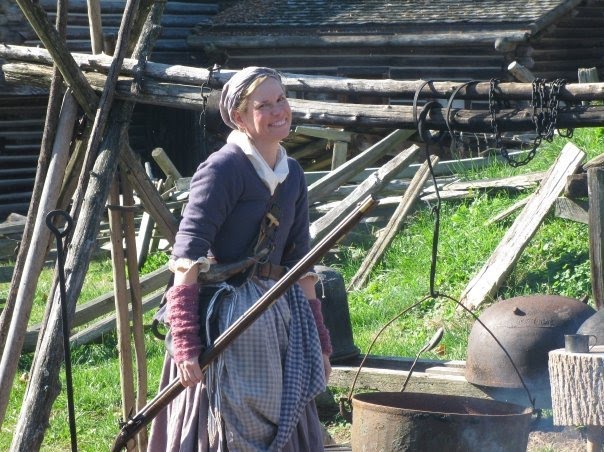


Suzanne, thank you so much for allowing me to use your photos, very much appreciated.
Regards, your Friend, Le Loup.
Subscribe to:
Posts (Atom)