
Wednesday, 20 March 2013


Tuesday, 19 March 2013
NARRATIVE OF THE CAPTIVITY OF WILLIAM BIGGS. Part 3.

It is a
law with the Indians when they go to war, if an Indian will
not
obey the counsels and commands of his captain or chief, to kill
them.
When their meat was cooked, they ate very hearty, and when they
were
done eating, three of the Indians got up, put on their budgets and
started,
this young Indian was one of them. I also got up to show a
willingness
to be ready. The old chief told me to sit down, and the
three
Indians started off. In about three or four minutes after we
started,
but varied a little in our course. We had not traveled more
than
one hundred yards when we heard the report of a gun. The old chief
then
told me that they had killed the Indian that wanted to kill me. The
other
two Indians fell in company with us before night. We then traveled
till
about 10 o'clock in the night, when we encamped at a large grove of
timber
in a prairie, about four miles from the edge of the woods; made
no fire
that night. We traveled about forty miles that day. After they
rested
a while they sat down to eat their jirk. They gave me some but I
could
not eat any. After they were done eating, one of the Indians was
sitting
with his back against a tree, with his knife between his legs. I
was
sitting facing him with my feet nearly touching his. He began to
inquire
of me of what nation I belonged to. I was determined to pretend
that I
was ignorant and could not understand him. I did not wish them to
know
that I could speak some Indian language, and understand them better
than I
could speak. He first asked me in Indian if I was a Matocush,
(that
is a Frenchman in English). I told him no. He asked me if I was a
Sagenash,
(an Englishman). I told him no. He again asked if I was a
Shemolsea,
(that is a long knife or a Virginian). I told him no. He then
asked
me if I was a Bostonely, (that is American). I told him no. About
one
minute afterwards, he asked me the same questions over again. I then
answered
him yes; he then spoke English and caught up his knife in his
hand,
and said "you are one dam son of a bitch." I really thought he
intended
stabbing me with his knife. I knew it would not do to show
cowardice,
I being pretty well acquainted with their manner and ways. I
then
jumped upon my feet and spoke in Indian and said manetway, kien,
depaway,
in English it is no, I am very good, and clapped my hand on my
breast
when I spoke and looked very bold; the other Indians all set up
such
ha! ha! and laugh that it made the other Indian look very foolish.
He sat
still and looked very sulky. After they had rested a while, they
began
to prepare to lay down. They spread down a deer-skin and blanket
for me
to lay on. They had tied a rope around my arms above my elbows,
and
tied that rope across my back, and a rope around my neck; they then
tied
the end of another rope behind to the neck rope, then down my back
to the
pinion rope; then they drew my hands forward across my stomach
and
crossed my wrists; then tied my wrists very tight; then tied my legs
together,
just below my knees; then tied my feet together with a rope
round
my ankles; then took a small cord and tied in between my wrists,
and
also between my ankles very tight, in order to prevent me from
drawing
out my hands or feet; they then took another cord and tied one
end to
the neck rope; then to the hand rope; then from the hand rope to
the
knee rope; they then took a rope about six feet long and tied one
end to
the wrist rope, and the other end to a stake about six feet from
me
stretched very tight, and an Indian laid on that rope all night; then
they
took another rope about the same length, and tied one end to the
knee
rope and the other end to a stake, and another Indian laid on that
all
night; then they tied a large half-dressed elk rope, one end to the
back
part of the neck rope which made a knot as big as my fist, the
other
end they tied to a stake about six feet from my head. When they
finished
their tying me, they covered me with a blanket. They tied me in
the
aforegoing way nine nights in succession; they had me stretched and
tied so
tight, that I could not move one inch to turn or rest myself;
that
large knot was on the back of my neck, so that I was obliged to lay
on it
all night, and it hurt my neck very much. I never suffered as much
in the
same length of time in all my life; I could hardly walk when we
got out
to their town. They never made me carry anything except a
blanket
they gave me to keep myself warm, when they took all my clothes
from
me. The Indians carried a deer-skin and blanket all the way for me
to
lodge upon. When my hands and feet became sore with the tying the
Indians
would always pull off my moccasins at night and put them on in
the
morning, and patch them when they would require it.
Monday, 18 March 2013
NARRATIVE OF THE CAPTIVITY OF WILLIAM BIGGS. Part 2

The Indians discovered that something was the matter and saw me tumbling
down
several times. I suppose they thought I was wounded and could run
no
farther; they then set up the yell again and mended their gait
running.
By the time I got my great coat loose from me, and was in the
act of
pulling off my under coat, I was pulling off one sleeve I looked
back
over my shoulder, but had not time to pull it off--the Indians
being
within ten yards of me. I then started again to run, but could not
gain
any ground on them, nor they on me; we ran about one hundred yards
farther
and neither appeared to gain ground: there was a small pathway
that
was a little nearer than to keep the big road,--I kept the big
road,
the Indians took the path, and when we came where the path comes
into
the big road the Indians were within three or four yards from
me--we
ran forty or fifty steps farther and neither appeared to gain
ground.
I expected every moment they would strike me with their
tomahawks--I
thought it would not do to be killed running like a coward
and saw
no other way to make my escape than to face about and to catch
the
tomahawk from the first that attempted to strike me, and jerk it
from
him, which I made no doubt but I was able to do; then I would have
a
weapon to fight with as well as them, and by that means I would be
able to
make my escape; they had thrown down their guns before they gave
me
chase, but I had not fairly faced about before an Indian caught me by
the
shoulder and held his tomahawk behind him and made no attempt to
strike
me. I then thought it best for me not to make any resistance till
I would
see whether he would attempt to strike me or not. He held me by
the
shoulder till another came up and took hold of me, which was only
four or
five moments; then a third Indian came up, the first Indian that
took
hold of me took the handle of his tomahawk and rubbed it on my
shoulder
and down my arm, which was a token that he would not kill me
and
that I was his prisoner. Then they all took their hands off me and
stood
around me. The fourth Indian came up and attempted to strike me,
but the
first Indian that caught me pushed him away. He was still
determined
to kill me, and tried to get around to my back; but I still
faced
round as he was trying to get to my back--when he got up by my
side,
he drew his tomahawk the second time to strike me, but the same
Indian
pushed him off and scolded him very much--he let his tomahawk
hang by
his side, but still intended to kill me if he could get an
opportunity.
The other Indians watched him very closely. There were but
four
Indians that gave me chase, they were all naked except their
breachcloth,
leggins and moccasins. They then began to talk to me in
their
own language, and said they were Kickapoos, that they were very
good
Indians, and I need not be afraid, they would not hurt me, and I
was now
a Kickapoo and must go with them, they would take me to the
Matocush,
meaning a French trading town on the Wabash river. When the
Indians
caught me I saw Mr. Vallis about one hundred yards before me on
the
road--he had made a halt. They shot him in the left thigh about
seven
or eight inches above the knee, the ball came out just below his
hip,
his horse was not injured--he rode an elegant horse which carried
him out
of all farther danger--his wound mortified, he lived six weeks
after
he was wounded, then died. I understood their language, and could
speak a
little. They then told me to march; an Indian took hold of each
of my
arms, and led me back to where they shot at me, and then went
about
half a mile further off the road, where they had encamped the
night
before and left their blankets and other things. They then took
off my
under coat and tied my hands behind my back, and then tied a rope
to
that, tying about six or seven feet long, we then started in a great
hurry,
and an Indian held one end of the rope while we were marching.
There
were but eight Indians marched in company with me that morning
from
the camp. The other eight took some other route, and never fell in
with us
again, until some time after we got to their towns. We had
marched
about three or four miles from that camp when Vallis arrived at
the
fort, about six miles from where they caught me, where they fired a
swivel
to alarm the people who were out of the fort--when the Indians
heard
the swivel they were very much alarmed, and all looked that way
and
hallowed yough, yough. They then commenced running, and run in a
pretty
smart trot of a run for five or six miles before they halted, and
then
walked very fast until about 2 o'clock in the afternoon, when they
separated,
I supposed to hunt, having nothing to eat. The old chief and
one of
the other Indians kept on a straight course with me, we traveled
about
three miles, when we got a little way into a small prairie and
halted
about fifteen minutes, there one of the party fell in with us, he
had
killed a bear and brought as much of the meat with him as he could
carry.
We then crossed the prairie and came to a large run about one
mile
and a half from where we had halted to rest. By this time three
Indians
had joined us. We halted there, made a fire and roasted the bear
meat,
the other two Indians staid behind as spies. Whilst the meat was
cooking,
the Indians held a council what they would do with the Indian
that
wanted to kill me. He was a young fellow about 19 years of age and
of a
different nation, being a Pottowatema. They did not want him to go
to war
with them; they said he was a great coward and would not go into
danger
till there was no risk to run, then he would run forward and get
the
best of the plunder, and that he would not be commanded; he would do
as he
pleased; was very selfish and stubborn; and was determined to kill
me if
he could get a chance. They determined in their council to kill
him.
Letter to our Local MP.
If you agree with what I have said here, I urge you to write to your own local state MP.
Keith H. Burgess. Wychwood
Forest, MSF 2007, Armidale 2350.
Dear Sir,
I have written to you before
regarding the matter of antique flintlock muzzle-loading firearms versus modern
made flintlock firearms. But as nothing has been done to amend the legislation
I thought it worth writing you again.
Antique flintlock muzzle-loading
pistols & long arms do not require a firearms licence, registration, or a
permit to purchase. Modern made copies of the exact same gun do require a
firearms licence, registration, & a permit to purchase. This makes no
sense, & the requirement of licences, registration & permits to
purchase also means more work for the NSW Firearms Registry & the Police.
The extra work & costs involved in separating 18th century
muzzle-loading guns from 21st century muzzle-loading guns is simply
not sensible.
This is not the only problem. A
few months ago I was subject to a firearms check. The police sergeant attending
was ignorant of the content of the firearms legislation. He did not know what a
muzzle-loading gun was & told me he would have to report me for having
illegal firearms that were not registered. These were antique muzzle-loading
guns made before 1900ad. By law he should have confiscated these guns if he
truly believed they were breech-loading firearms that required licence &
registration, but he did not. I then at my own expense had to take my guns to a
gunsmith in Arding so that he could verify that these guns were in fact
muzzle-loading firearms & that they were in deed antiques.
Recently I purchased what was
supposed to be an antique flintlock pistol. This pistol however turned out to
be a copy. The person who sold it to me broke the law be posting this firearms
through the mail, because it was not an antique. By law I had to turn this gun
over to the police, so I took it to Armidale police station. The police did not
want it! They had never seen a muzzle-loading gun before & were not
interested. They told me to forget about it & take it home again!
Due to
this ridiculous legislation I could not do this & so had to insist that
they take this pistol, log it & give me a receipt. The point here is that
the police themselves don’t care whether or not anyone owns a muzzle-loading
pistol, so why is such a gun restricted by law? There is no difference between
a flintlock muzzle-loading pistol made in 1750ad & the same identical gun
made in the 21st century. It is not as if the guns made now were
actually breech-loading & just made to look like a muzzle-loader, this is
not the case. These modern made flintlocks are in every way the same as the
originals. They need a piece of rock to create sparks to ignite the priming
powder which in turn has to ignite the main charge. No wonder the police are
not interested in these guns.
([2] Section 6A Exemption for certain firearms
manufactured before 1900
Omit section 6A (1). Insert instead:
(1) A person is exempt from any requirement under this Act to hold
a licence or permit in respect of the possession of an antique
firearm.
An antique firearm is defined and
one made before 1900, with the same commercially available ammunition
requirements as before . A
functioning copy of an antique firearm is a replica firearm and is treated the
same as modern firearms, regardless of the availability of commercial
ammunition. The corresponding clauses of the Firearms Regulation 2006 are repealed, moving control of
antiques to the main act from the reg.
To take all flintlock muzzle-loading
guns, including flintlock pistols, off licence, off registration & off
permit to acquire would save the Government a lot of money & free up Police
service staff for more important duties.
Your assistance in getting this
legislation amended would be greatly appreciated.
Yours very sincerely,
Keith H. Burgess.
New England Colonial Living
History Group 1680-1760. N.E.C.L.H.G.
Member of: Australasian Living
History Federation. A.L.H.F.
Registered with: Australia
Register of Living History Organisations. A.R L H.O.
Sunday, 17 March 2013
NARRATIVE OF THE CAPTIVITY OF WILLIAM BIGGS
My thanks to the American Indian History blog for bringing this narrative to my attention.
http://americanindianshistory.blogspot.com.au/

http://americanindianshistory.blogspot.com.au/
The
Project Gutenberg EBook of Narrative of the Captivity of William Biggs
among
the Kickapoo Indians in Illinois in 1788, by William Biggs
NARRATIVE
OF THE CAPTIVITY OF _WILLIAM BIGGS_AMONG THE KICKAPOO INDIANS IN Illinois in
1788
Written
By Himself
NARRATIVE
OF THE CAPTIVITY OF WILLIAM BIGGS
AMONG
THE KICKAPOO INDIANS IN ILLINOIS IN 1788
This narrative of William Biggs capture shows the importance of wearing your clothing and equipment in a proper and secure manner. Had Biggs payed proper attention to the securing of his saddle and the load he was carrying, it is quite possible that he would have escaped this ambush.
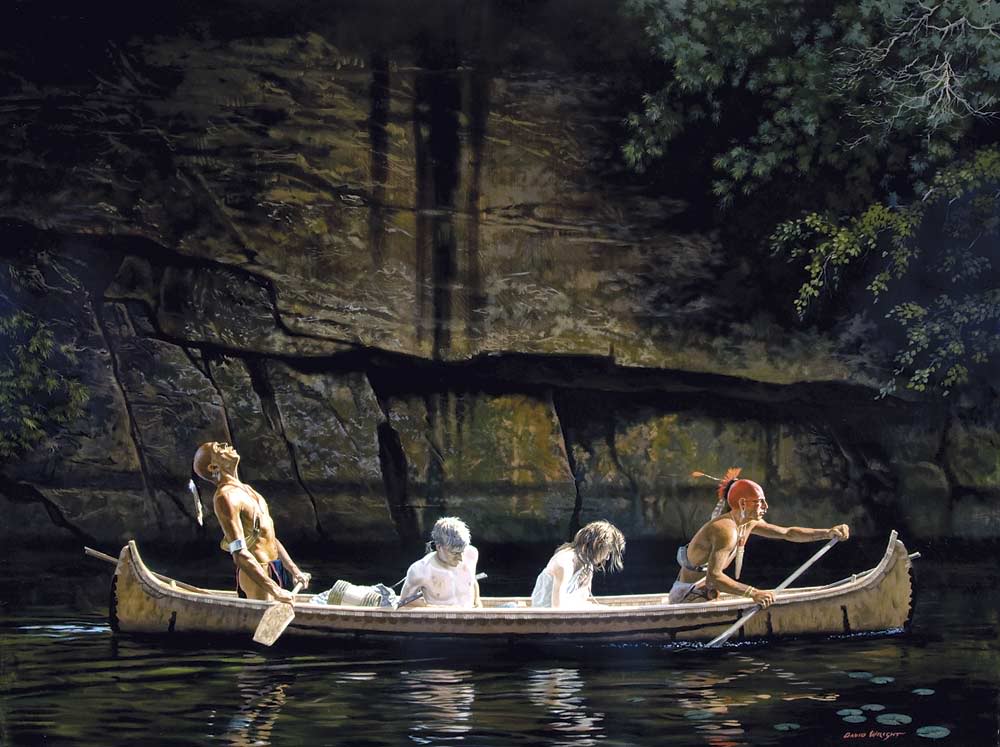
Captives, By David Wright.
In the
year 1788, March 28th, I was going from Bellfontain to Cahokia,
in
company with a young man named John Vallis, from the State of
Maryland;
he was born and raised near Baltimore. About 7 o'clock in the
morning
I heard two guns fired; by the report I thought they were to the
right;
I thought they were white men hunting; both shot at the same
time. I
looked but could not see any body; in a moment after I looked to
the
left and saw sixteen Indians, all upon their feet with their guns
presented,
about forty yards distant from me, just ready to draw
trigger.
I was riding between Vallis and the Indians in a slow trot, at
the
moment I saw them. I whipped my horse and leaned my breast on the
horse's
withers, and told Vallis to whip his horse, that they were
Indians.
That moment they all fired their guns in one platoon; you could
scarcely
distinguish the report of their guns one from another. They
shot
four bullets into my horse, one high up in his withers, one in the
bulge
of the ribs near my thigh, and two in his rump, and shot four or
five
through my great coat. The moment they fired their guns they ran
towards
us and yelled so frightfully, that the wounds and the yelling of
the
Indians scared my horse so that he jumped so suddenly to one side of
the
road, that my gun fell off my shoulder, and twisted out of my hand;
I then
bore all my weight on one stirrup, in order to catch my gun, but
could
not. I had a large bag of beaver fur, which prevented me from
recovering
my saddle, and having no girth nor crupper to my saddle, it
turned
and fell off my horse, and I fell with it, but caught on my feet
and
held the mane; I made several attempts to mount my horse again; but
the Indians
running up so close, and making such a frightful yelling,
that my
horse jumped and pranced so that it was impossible for me to
mount
him again, but I held fast to my horse's mane for twenty or thirty
yards;
then my hold broke and I fell on my hands and knees, and stumbled
along
about four or five steps before I could recover myself. By the
time I
got fairly on my feet, the Indians were about eight or ten yards
from
me--I saw then there was no other way for me to make my escape but
by fast
running, and I was determined to try it, and had but little
hopes
at first of my being able to escape. I ran about one hundred yards
before
I looked back--I thought almost every step I could feel the
scalping
knife cutting my scalp off. I found I was gaining ground on
them, I
felt encouraged and ran about three hundred yards farther, and
looking
back saw that I had gained about one hundred yards, and
considering
myself quite out of danger. A thought then occurred to me,
that I
was as safe and out of danger as I would be if I were in the City
of
Philadelphia: the Indians had quit yelling and slacked their
running--but
I did not know it then. It being a tolerable cold morning
and I
was heavily clad, I thought perhaps the Indians would give me a
long
chase, and probably that they would hold out better than I could;
although
at that time I did not feel the least tired or out of breath. I
concluded
to throw off my two coats and shoes, as I would then be better
prepared
for a long race. I had my great coat tied around me with a silk
handkerchief
pretty much worn--I recollect tying it with a slip knot,
but
being in a hurry, it was drawn into a double hard knot; I tried some
little
time to get it loose--the longer I tried the harder the knot
seemed
to get, that stopped my running considerably; at length I broke
it by
some means, I do not know how. In the morning I forgot to put on
my shot
pouch before I put on my great coat, and then put it on over it.
I
pulled off the sleeves of my great coat, not thinking of my shot-pouch
being
over my coat, it having a very short strap, the coat got so tight
in the
strap that I could not get it loose for a considerable time.
Still
trying, it hung down and trailed on the ground, and every two or
three
steps it would wrap around my legs and throw me down, and I would
catch
on my hands and knees, it served me so several times, so that I
could
make no headway at running. After some considerable time, I broke
the
strap and my great coat dropped from me--I had no knife with me.
Historical Trekking Dates 2013.
New England Colonial Living History group 1680-1760.
Winter Historical Trek
2013.
This year we will also
be camping in Butterfly Valley. We are at present in the process of cutting a
trail in to cut winter wood. This will be a good opportunity to check the area
out and maybe put some timber aside for constructing shelters.
There are a few
alternative routes into the camping area, depending on whether you want a short
easy trip or a longer trek. A header stream runs through this valley, and in
the camping area there is another stream which joins the header stream.
Anyone interested in
constructing a shelter beforehand let me know. Otherwise I will either do it
alone or wait until the actual trek.
The first trek will
take place on Friday 31st of May 2013. This will last the whole
weekend so members can attend anytime over that weekend. There may also be
shorter treks taken before that date for shelter construction so if you are
interested, contact me for details.
Regards, Keith.
Wednesday, 13 March 2013
Subscribe to:
Posts (Atom)